Showing posts with label El Salvador. Show all posts

Wednesday, June 3, 2015

That's right, 635 May homicides in tiny El Salvador

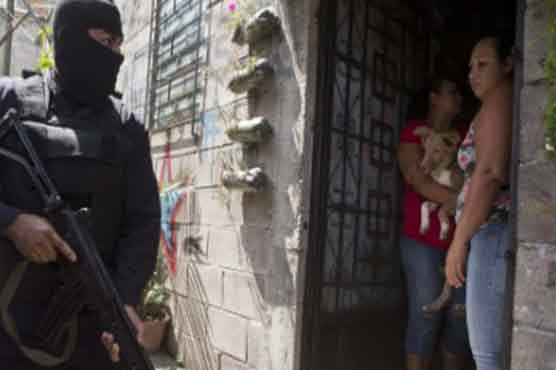
One year into President Salvador Sanchez Ceren's term, the country's security situation worsens. In May, 635 Salvadorans were murdered, an average of 20.5 per day.

    Most of the killings came during turf battles involving gang members mixed up in drug trafficking and extortion rackets, officials said Tuesday. Authorities described a deliberate attempt by criminal organizations to ramp up violence as a means of pressure.

    Justice Minister Benito Lara also blamed gang reaction to recent transfers of 2,600 jailed gang members, including a number of capos who were sent to a maximum-security prison and lost many benefits they had previously enjoyed in other lock-ups.

    National police director Mauricio Ramirez Landaverde said 60 percent of the victims were criminals killed by rival gangs or by colleagues in the same criminal group.

Unfortunately, June has started off even worse with 38 deaths on June 1. The year end rate is likely to be much worse than that estimated after the first four months of the year.


In other news, Gains in Education and Poverty Reduction Continue During Salvadoran President's First Year in Office and Salvadoran President Emphasizes Social Gains in 1st Year Speech. These are real improvements, if true, but hard to see how they are going to be sustainable amidst the current violence.


El Salvador has also signed onto a multilateral convention to fight tax evasion.


Fortunately, the economy looks to be growing again. Sanchez Ceren envisions growth to arrive at 2.5% in 2015 which is still rather poor even if it is better than it has been the last few years.


I'm going to be in El Salvador for two weeks in July. Shoot me an email if you are interested in meeting up.

Monday, June 1, 2015

Postulator of Oscar Romero's beatification cause under investigation for embezzlement

The postulator of Archbishop Oscar Romero's beatification and canonization cause, Italian Archbishop Vincenzo Paglia, is now under investigation by Italian officials for embezzlement.

    In 2011, Archbishop Vincenzo Paglia reportedly bought a 14th century castle with the intention of reselling it for a profit, according to catholicphilly.com, which adds that diocesan funds may have been used.

    Paglia, who heads the Pontifical Council for the Family, said in a statement he remains "at the disposition of the investigating authorities and I have full confidence in the justice system."

    Investigators are looking into the sale of the castle and allegations of possible conspiracy and fraud.

There doesn't appear to be any impropriety connected with Romero's cause but Salvadorans can't catch a break. Fortunately (?), the news didn't break prior to last weekend's ceremony in San Salvador.


Tim and John have posted posted some thoughts on Romero's beatification in recent days while Super Martyrio has the Romero Beatification Compendium available on his website. Michael Busch also shares some thoughts with Remembering Romero.

Wednesday, May 27, 2015

"We shouldn't teach this, because no one knows it"

@RaulAReyes argues that Oscar Romero's beatification is Pope Francis' powerful signal to the poor. It's good. I got a kick out of this quote:
It is unfortunate that many Americans have probably never heard of Romero. Like Mahatma Gandhi and Rev. Martin Luther King Jr., he was a believer in nonviolence and the innate dignity of all people. Sadly, just like Gandhi and King, Romero died a violent death. A champion of the poor, Romero was shot and killed while celebrating Mass in a hospital chapel 35 years ago. He was 62.
Well, we all know who is responsible for the failure of US citizens to know Oscar Romero's story.
The Texas Board of Curriculum.

Monday, May 25, 2015

The killing of Archbishop Oscar Romero...Was the CIA to blame?

Tom Gibb has a report on the killing of Monsenor Romero in The Guardian with The killing of Archbishop Oscar Romero was one of the most notorious crimes of the cold war. Was the CIA to blame?
However, new evidence suggests that Washington not only knew far more about the killing than it admitted - but also did nothing to investigate for fear of jeopardising its war effort. Vital evidence was ignored. Key witnesses, including the most likely gunman, were killed by those supposed to be investigating.
Seven years and 50,000 deaths after Romero's murder, I was feeling out of my depth as a novice reporter sitting on a park bench talking to a young deserter from Major D'Aubuisson's death squads who called himself Jorge. In 1984, he told me, he had guarded a safe house for three former guerrillas nicknamed the Little Angels. They spent their days with prostitutes, smoking marijuana and playing rock music at full volume. At night, they sallied out to capture and kill their former rebel comrades.
The men received orders from a National Police detective, Oscar Perez Linares, who came to the house. A man of few words, he was treated by the others with the respect reserved for those not afraid to kill. Several times, Jorge heard the others laughing at how Linares had shot Romero. Linares sat with a half-smile. "You should have seen the blood that came from that priest!" was his only comment.
Some of it is new, some not so new. At this point, I honestly sometimes forget what is the most recent knowledge. Close collaboration between death squads "led" by Roberto D'Aubuisson and the Salvadoran military. The US CIA doing a lot of dirty work, often in an "advisory" role. Our CIA helped to establish (not sure the right word - structure? improve?) Salvadoran death squads. The US unable to gain leverage over Salvadoran military units to fight the right way but unable to gather human intelligence the way the Salvadorans did. The right and the left both infiltrated each other's organizations and used information from spies to kill each other.

Here's more from a 2010 interview with one of the accomplices in Romero's death.

Saturday, May 23, 2015

Twentieth Century Peacemaker: Archbishop Oscar Romero

Thirty-five years ago, Catholic Archbishop Oscar Romero was assassinated by a right-wing death squad in El Salvador. In February, Pope Francis recognized Romero as a martyr who had been killed “in hatred of the faith.” On Saturday, the Church will beatify the late Archbishop Romero at a ceremony in San Salvador, bringing him one step closer to sainthood. While Catholics and non-Catholics inside and outside of El Salvador have, unofficially, considered Romero a saint for nearly three decades, his beatification gives us another opportunity to reflect on one of the twentieth century’s greatest peacemakers.

Oscar Romero had initially been chosen Archbishop because the Church hierarchy believed that he would not make too many waves in turbulent 1970s El Salvador. While he was a man of deep faith and concern for the poor, he was not one who connected people’s poverty to unjust social, political, and economic structures. Instead, Romero fed the hungry, visited the imprisoned, and called on friends in authority to help struggling Salvadorans. However, the fraudulent 1977 elections, the murders of thousands of poor Salvadorans, and the repression of the Church, including the murder of his friend Fr. Rutilio Grande, S.J., further opened his eyes to the causes of the suffering around him. Romero listened to the cries of the poor. His Tutela Legal office collected testimonies documenting human rights abuses, mostly by the State’s security forces, which he would then share with the entire country during his Sunday homilies. It was one way that he would give voice to the voiceless.

His faith not only led him to speak out against the violence, but to become more involved in actively working to resolve the country’s problems. On October 15, 1979, junior military officers carried out a bloodless coup in hopes of preventing further bloodshed between the armed left and right. The coup plotters had the support of the Jesuit-run University of Central America, technocrats, the Christian Democratic Party, and the Communists. They also had the support of the Archbishop who was not afraid to get his hands dirty in politics.

Romero’s desire to “keep to the center, watchfully, in the traditional way, but seeking justice,” won him few friends among the revolutionaries and counter-revolutionaries. There was no consensus among the armed left on how to respond to the coup as its success would derail their revolutionary dreams. These political-military organizations would go on to establish the Farabundo Martí National Liberation Front (FMLN) one year later. The far-right, on the other hand, interpreted the coup as playing into the hands of the “communists,” thereby undermining their privileged position in society. They thwarted many of the junta’s reforms and increased repression against the popular sectors. Some of these individuals would go on to establish the Nationalist Republican Alliance (ARENA) in 1981.

When the Carter administration sought to provide additional military assistance to El Salvador in hopes that the US and the new government would gain leverage over extreme elements of the military and right-wing, Archbishop Romero wrote President Carter expressing his opinion that such a policy would only worsen the situation. US military support, “rather than favoring greater justice and peace in El Salvador will make injustice and repression against the organization of the people, who have been struggling for the respect of their most fundamental rights, even more acute.” The groups over which the US sought to gain leverage “only know how to oppress the people and favor the interests of the Salvadoran oligarchy.”

On March 23, 1980, Archbishop Romero pleaded with members of the Salvadoran military to stop killing their brothers and sisters. He told them that one must obey the law of God even if it was contradictory to the orders of one’s military superiors. He had sealed his own fate. He was shot and killed while saying Mass the next day. The coup’s failure and Romero’s murder ushered in over a decade of war, costing the lives of over 75,000 Salvadorans.

While there have been calls for canonization since his death, his beatification has only become reality after changes in El Salvador and the Catholic Church. Three Salvadoran ambassadors to the Vatican lobbied against Romero, “arguing that Romero was still a politically divisive figure in El Salvador and that his elevation to the altars could be manipulated by the leftist groups.” Romero’s image often appeared on t-shirts alongside those of Ché Guevara and Salvador Allende, as well as Salvadoran Communist leader Schafik Handal. Through no fault of his own, Romero’s association with these leftist icons did not help his cause. While time has not healed all wounds, the end of the Cold War reduced the political stakes over whether Romero was killed for his politics or his faith. A truth commission identified Roberto D’Aubuisson, one of ARENA’s founders, as the man responsible for ordering Romero’s murder. ARENA occupied the presidency of El Salvador between 1989 and 2009. While El Salvador is still divided politically, ARENA formally supported Romero’s canonization in 2007. The risk that the right would object to a celebration of Romero by turning to violence is lower than at any other time in history.

Two years ago I argued that "the selection of a Latin American Pope might give added hope for the canonisation of the murdered Archbishop Oscar Romero of El Salvador." That certainly seems to have been the case as several stories have since emerged indicating that Pope Francis had unblocked Romero’s canonization in April 2013. However, it appears that Pope Benedict XVI had also decided to unblock the process in 2012. Romero’s beatification was instead held up by conservative Latin American bishops who feared it would embolden the more liberation-oriented wing of the Church in Latin America. Francis’ support for Romero certainly helped, but obstruction in El Salvador and the Americas seems to have been just as important.

For me, Romero’s Catholic faith led him to struggle in favor of the poor and the oppressed. This humble Servant of God’s faith threatened those on the armed left and right who chose violence to further their agenda. And the right killed him for it. Romero’s beatification should provide Catholics and non-Catholics alike with an opportunity to learn more about one of the twentieth century’s greatest peacemakers.

Friday, May 22, 2015

Oscar Romero's beatification: Thirty-five years in the making

On Saturday, hundreds of thousands of people will descend upon El Salvador to celebrate the beatification of Archbishop Oscar Romero. There's been a lot written about Oscar Romero these last few days but here are a few highlights.

I had the privilege and honour of meeting, interviewing, and getting to know “Monseñor”—as he was affectionately called.  He was one of the moral giants of the late 20th century—up there with Martin Luther King, Jr., Nelson Mandela, Desmond Tutu, and other Latin American Catholic bishops who spoke truth to power during the dark years of military dictatorships.  I have never known anyone as humble, as clear in his faith, as courageous and unflinching. 
Carlos Dada of El Faro has The Beatification of Óscar Romero in The New Yorker.
The Church has now declared that Romero was killed because of his faith. Yet the death squads, the military, and the wealthy financiers of his killing all professed to be followers of Christ. Some of them, still alive, are active members of church communities, give lots of money to Catholic conservative organizations, send their kids to Catholic schools, and never miss a Sunday Mass. They say that they have God to thank for all their possessions (never mind their corruption, exploitation of the poor, repression, impunity, and historical position as the effective owners of the state). On religious grounds, they firmly oppose abortion, gay marriage, and birth control. They were not opposed to killing thousands of people who challenged their point of view. And, during the reigns of John Paul and Benedict, they also had leverage in Rome.
Rep. Jim McGovern published Time to Answer Romero's Call to Action in The Huffington Post.
I am hopeful that the power of Romero's message can inspire new activism on behalf of the poor and a better understanding of their plight and struggles -- in El Salvador, the United States and around the world. Romero reminded us, "There are many things that can only be seen through eyes that have cried." With the beatification of Romero, we have an opportunity to renew our commitment and honor his legacy by giving a voice to the poor and neglected in every nation. Now is the time to stand on the right side of history and help those who need it most.
I submitted a post as well and will post it here tomorrow if I don't here back from anyone. In case you can't wait, here are my thoughts from 2010.

Monday, May 18, 2015

Homicides continue to increase in El Salvador

Fred Ramos / For the Washington Post
Joahua Partlow has a depressing story on the increasing violence in El Salvador for the Washington Post with El Salvador is on pace to become the hemisphere’s most deadly nation.
Amid a public outcry and mounting government pressure, El Salvador’s anti-gang police have ratcheted up their operations, killing suspected gang members and arresting more than 4,400 others this year. New laws have made it harder to investigate police violence. The country’s vice president, Oscar Ortiz, has said that police “must use weapons and should do so without fearing consequences for their actions.”
Within police ranks, there is both fear and law-and-order bravado, an edgy, confrontational climate that human rights groups say evokes memories of the brutal 1980s civil war.
His update on events in El Salvador made me think of an op-ed I wrote for Al Jazeera three years ago (A second chance for President Funes in El Salvador) in which I argued that the Salvadoran government deserved credit for supporting the gang truce, but that it must reform its own approach to the 'problem'.
Funes and his government deserve credit for supporting the truce and for reaching out to national and international businesses and organisations for support. Unfortunately, it does not appear that the Funes administration has used the truce to restart its basic approach to poor and marginalised youth. It's not clear that they have made a commitment to scale back the Mano Dura policies of recent years that contributed to this violence.
The government and its security forces need to stop seeing every young person as a gang member or a potential gang member. According to some gang members, the truce has been difficult to sustain because some police officers have been arresting and beating gang members just "for fun". In the months following the truce, the police have continued to round up suspected gang members - even though it is unclear what crimes they had committed other than being a gang member. Imprisoning Salvadoran youth because of their tattoos and general appearance rather than their behaviour contributed to an escalation of violence and needs to stop.
It was not too long ago that General David Munguia Payes said that the Salvadoran government has a "Plan B" which is more direct against the problem, although he would not go into details. If Plan B is some super super Mano Dura, the Funes administration will have learned nothing.
For the truce to hold, it'll take more than a change of heart by gang members. The Funes administration needs to recommit itself to a comprehensive anti-gang strategy that emphasises prevention, reintegration and rehabilitation. It also needs to reform the country's public security institutions away from a Mano Dura approach to societal ills.

Tuesday, May 12, 2015

Spain continues to investigate UCA Jesuit murders


The Spanish Supreme Court recently ruled in favor of a High Court judge's continued investigation into the murders of the Salvadoran Jesuits and their companions. The Supreme Court ruled that reforms made to the country's universal justice doctrine (done so under pressure from China) does not prevent an investigation into the case of the UCA martyrs.

The Supreme Court ruled that because five of the eight victims were Spanish, the investigation can continue. The Court also ruled that the investigation can continue because the Salvadoran government's decision to prosecute low level soldiers in 1991 was done so not in the pursuit of justice, but as part of an effort to deflect attention away from superiors who ordered the killings (somewhat liberal interpretation on my part).
Passed by Congress with the sole support of the Popular Party (PP), part of the text of the new law states that Spain cannot investigate some crimes committed in other countries where judicial proceedings have already been opened unless there are indications that a foreign government cannot or is unwilling to prosecute.
Two retired military officers, Colonel Alfredo Benavides Moreno and Lieutenant Yusshy René Mendoza Vallecillos, were convicted by a Salvadoran jury in 1991 and sentenced to 30 years in prison for the massacre. However, they were both freed under a government amnesty two years later.
In its opinion, Spain’s Supreme Court said that there were “serious and reasonable” indications that the 1991 jury trial was not held to find those responsible for the murder but instead to obstruct justice, “all of it accompanied by the absence of the necessary guarantees of independence and impartiality.”
In other news, Tim has Destructive waves returning to El Salvador and Big business failing to pay taxes in El Salvador and IPS has Talk of Death Squads to Combat New Wave of Gang Violence in El Salvador.

Wednesday, May 6, 2015

A CICIG for the Northern Triangle

Fulton Armstrong and Héctor Silva on CICIG: Model for Northern Triangle:
Nonetheless, CICIG is nearly universally seen as providing assistance that all three countries of the “Northern Triangle” of Central America need – to foment rule of law, build confidence in justice, and clean up state institutions – and it has achieved reforms when the political will was sustained.  CICIG’s status as an advisory body in support of the government has enabled it to finesse the legal and political need to fully respect sovereignty.  
Honduran and Salvadoran leaders have made statements suggesting openness to the idea but, apparently for different reasons, don’t want independent investigators upsetting the applecart.  Salvadoran President Sánchez Cerén has less to fear from examination of his administration and his predecessor’s record on impunity and organized crime, but he may be concerned that a CICIG-style unit would dangerously aggravate his opponents, who retain intimidating power through many sectors.  The failure to push for CICIG to realize its full potential in Guatemala and for similar mechanisms in El Salvador and Honduras will only slow the sort of reforms the Northern Triangle needs to overcome its political, social, and economic challenges crises.
CICIG was forced upon Guatemalan politics nearly a decade ago after years and years of criticism from the international community and domestic civil society. There's been no equivalent pressure for Honduras and El Salvador to adopt a similar program. In my opinion, CICIG has done a very good job tackling impunity but much work remains to be done. Reducing impunity from 98% to 85% or so means that conditions are still terrible. What's really impressive about CICIG's work is that they have done it on the cheap. $12 million per year is nothing. That's a terrific return on investment.

Extending CICIG to El Salvador in 2009-2010 would have been ideal. A "international" commission could have provided greater legitimacy for investigations launched into organized crime that were linked to previous administrations. Six years into FMLN rule, I'm not sure that the FMLN would come across that clean and, therefore, would be reluctant to call for the creation of a similar commission in El Salvador.

In Honduras, I called for creating a CICIG-type institution there two years ago. My opinion hasn't changed.

Since it is becoming increasingly unlikely that President Obama will get his $1 billion for the Northern Triangle, let's try to $200 million to have CICIG's in all three countries. That'll cover 5 1/2 years of international commissions operating in each country (or maybe one cross-national body).

Saturday, May 2, 2015

Protecting workers' rights in El Salvador

Lydia DePillis has an interesting article on Why it’s so hard to protect workers caught in global supply chains in the Washington Post that uses El Salvador as an example.
What happened at Rivera’s factory illustrates one of the biggest problems in the global supply chain: How to protect workers in a brutally competitive industry where factories constantly close and open, as brands chase new trends and lower costs, and no one is held accountable for laws broken along the way.
Like most developing countries, El Salvador has no real form of workers compensation, but it does require factory owners to pay people lump sums in the event of a closure — usually about a month of salary for every year worked. That can be the largest amount of money a worker ever sees at one time, and it’s essential to tide them over until they find a new job.
But all too often, the factory owners don’t pay up — it’s a large sum, at a time when the factory is often in financial distress. Liquidating their assets takes a painfully long time, and usually doesn’t yield enough. And left to their own devices, apparel brands have little incentive to force factories to set aside money for future severance payments, since that might increase costs.
Hanes is one of the companies that ponied up when a factory it purchased materials from closed down and the owner of that factory failed to pay the legally required severance to workers. I guess that is one of the reasons why HanesBrands was honored by the Great Place to Work Institute for its workplace practices in its Salvadoran manufacturing plants.

However, it's not all good news. A union activist alleges that the owner that closed the factory did so because its workers had attempted to unionize.

Friday, May 1, 2015

What Should Be Done to Reduce El Salvador's Homicides?

Christine Wade, Ricardo Cevallos, Adam Blackwell, and Douglas Farah contributed answers to the following questions from the Inter-American Dialogue's Latin America Advisor:
El Salvador suffered its highest monthly homicide rate in a decade in March, with 481 murders. And since the beginning of the year, 23 police officers and six soldiers were killed in confrontations with gang members in the Central American country. In response to the growing homicide rate in El Salvador, where a gang truce broke down last year, President Salvador Sánchez Céren created three new "rapid response" battalions for the army and one for the police. Why is El Salvador's murder rate increasing? Is Sánchez Céren taking the right steps to reverse it? What more should he be doing?
Here was Christine's answer
"What we see today in El Salvador is a result of the failure of previous administrations to address the legacy of societal violence, invest in education and social programs, and implement reforms that would strengthen the rule of law while respecting human rights and address impunity. While some minor advancements were made in these areas during the Funes administration, the reliance on militarized policing by both the Funes and Sánchez Céren administrations is disappointing but unsurprising given the past dependence of such policies. And while militarized policing may be popular, it is also ineffective and counterproductive—not to mention a violation of the peace accords.
The Sánchez Céren administration needs a comprehensive program to address societal violence, impunity and corruption. This is key because anyone who thinks that the violence in El Salvador is just about gangs is kidding themselves. But a comprehensive program in addressing these issues is the long game, and the escalating gang violence in the country demands a short game as well. Stemming the current wave of violence is not only key to saving lives and building public confidence, but is also necessary to create the political space to engage in dialogue to develop a more comprehensive plan. Last week, the administration introduced a draft gang rehabilitation law. At first glance, it appears to be the most comprehensive and promising policy we've seen on gangs to date. If the draft law becomes a reality, it will require sustained domestic and international support to succeed."
You can read the rest of the answers here.

Monday, April 27, 2015

God Alone Was With Us: 1981 massacre of Santa Cruz, El Salvador


In November, 1981, during the height of the Salvadoran armed conflict, an estimated 1,200 soldiers invaded the rural northern province of Cabañas, El Salvador, to carry out a “cleansing operation.” Survivors of the invasion, however, tell a story of carnage, in which the armed forces directly targeted the unarmed civilian population, including the elderly and women carrying children, using ground forces and aerial bombardment and resulting in the death of untold numbers of campesinos. In particular, hundreds are estimated to have been killed in the massacre of Santa Cruz, which took place at the site of the schoolhouse in Santa Cruz, in the municipality of Ilobasco, department of Cabañas, on November 14, 1981.
Since 2013, Unfinished Sentences has worked with partners in El Salvador, Spain, and the United States in an effort to understand and document what happened at Santa Cruz. Today we present the report God Alone was with Us, the first comprehensive study of this massacre, along with an 18-minute documentary detailing the events of the massacre and survivors’ renewed fight for truth and justice.
Unfinished Sentences presents God Alone Was With Us: Report and video document 1981 massacre of Santa Cruz.

Thursday, April 23, 2015

"Political facade for repression" in El Salvador?

The AFP has an update with what is going on with As gang violence surges, El Salvador fears bloody war. After two years of escalating violence, including a "bloody first three months of the year, in which 23 police and six soldiers were killed in clashes with gangs" and the most violent month in over a decade, President Salvador Sanchez Ceren has up the ante by establishing "four 'rapid response' battalions -- one for the police and three for the army." He has also ordered the transfer of gang leaders currently held in the country's prison system to locations which will make it more difficult for them to communicate with family and associates.
The country is now in a "defining moment" in its drawn-out fight against the ultra-violent gangs Mara Salvatrucha and Barrio 18, said security expert Juan Ramon Medrano.
"The government has not given up on prevention and rehabilitation, (but) it is fighting the gangs with intensifying repression, which has unleashed an escalation of violence," he told AFP.
In addition to creating the rapid response battalions (horrible name, no?), the army has increased its troop presence in areas of the country where they have received intelligence that gang members have been receiving sophistical training. The response in escalation by the police and government comes after the government established a Public Security Council which presented a $2.1 billion prevention and policing plan to address the insecurity.

Raul Mijango criticizes the plan as a "political facade for repression" which, in some ways, would put it in the same vein as those plans launched by ARENA's Flores and Saca. Two differences, however, might be that ARENA seemed to have pursued its mano dura policies of a decade ago with fewer concurrent investments in other areas and it did so simply with electoral considerations in mind.

There wasn't the equivalent support for social programs such as has happened under the FMLN - health, education. And there wasn't much of a plan - let's just make it look like we are doing something, something that a large percentage of the population wanted, until the elections are over. Locking people up until the elections are over (what 90% were released within a few months of the elections?) wasn't much of a plan.

Rightfully so, Salvadoran media has been very critical of Sanchez Ceren and the FMLN's approach to public security. So has international coverage to a certain extent. I still feel, however, that the criticism has been somewhat muted simply because the FMLN is carrying out this plan rather than ARENA.

Tuesday, April 21, 2015

Early attempts to negotiate an end to the Salvadoran civil war

Ricardo Valencia carried out a brief interview with Salvadoran Ambassador to the United States Francisco Altschul for the USC Center on Diplomacy's CPD Blog. Ambassador Altschul was a member of the FMLN-FDR diplomatic commission during the civil war and spent a great deal of the war engaged in public diplomacy in the United States and Europe.
The FMLN-FDR's job was to promote and to sell the idea of the urgency of a political settlement in Washington, D.C. The basic idea was to make people understand that the best solution for everybody involved was the process of dialogue and negotiation, and that the FMLN was serious in its call for a political settlement, the idea of negotiations was not simple tactical move.
I'm pretty sure that Ambassador Altschul was referring to the late 1980s but there were also moments in the early years of the war where the FMLN and moderate civilian and military officials as well as the Cubans were exploring the possibility of a political solution.

In Back Channel to Cuba: The Hidden History of Negotiations between Washington and Havana, William LeoGrande and Peter Kornbluh document efforts by Cuba to reach out to the US to resolve the Salvadoran civil war through negotiations. El Faro has an excerpt (more of less).

In February 1981, Cuba reached out to the US and indicated its support for negotiations. As a demonstration of good will, the Cubans had reduced military support for the FMLN. Here we are only weeks removed from the FMLN's first final offensive and Reagan's January 20th inauguration. The Mexican government also tried to mediate in July, October and November 1981 and then February to April 1982. Lopez Portillo's government had become very close to Nicaragua and had become very engaged in Central America overall, which didn't sit well with the US. The Mexican and French governments would then sign A Common Position Between Mexico and France Regarding El Salvador, which would recognize the FMLN as a belligerent force in 1981.

From what Alberto Martin and I have found, the Cubans were encouraging the FMLN and the URNG to negotiate a political solution to the war so as to consolidate the revolutionary processes in Cuba and Nicaragua. Another victory by leftist forces in El Salvador, less likely Guatemala, might have increased the possibility of direct US military intervention on the isthmus - something that they wished to avoid. Here is what we wrote in Unity and Disunity in the FMLN (let me know if you'd like a copy):
The available information suggests that the PCS, the RN, and the Popular Social Christian Movement (MPSC) explored the possibility of negotiations with the governing junta, controlled by the PDC, before the March Constituent Assembly elections (U.S. Department of State 1982).3 According to Eduardo Sancho, a former RN leader and member of the FMLN General Command, the FMLN signed a pact in Havana in 1982 on the initiative of the RN and the ERP, whereby it agreed to renounce its pursuit of a dictatorship of the proletariat and to accept a democratic process (Sancho 2004). Not everyone agreed with the declaration, but after making clear his reservations, FPL general secretary Carpio signed the agreement.
It is important to mention that the Cuban and Sandinista governments supported the combined strategy of negotiation and armed struggle and even pressured Carpio into accepting this change (Sancho 2004; Kruijt 2008, 64).5 Havana was apparently willing to sacrifice the revolution in El Salvador (and Guatemala) in exchange for the consolidation of the Sandinista revolution. In August 1983, the Cuban government made the U.S. government aware of its willingness to stop supplying weapons to the FMLN and to persuade FMLN leaders to participate in the political process in exchange for the United States’s ceasing its support for the Contras (U.S. Department of State 1983). The U.S. escalation in El Salvador and the slim prospect for a quick FMLN triumph were responsible for the new Cuban perspective.
This battle over FMLN political and military strategy in El Salvador contributed to the murder of Ana Maria and the suicide of Carpio.

It's possible that Cuban overtures were sincere, but the US did not trust the Cubans. I'm not entirely convinced that the FMLN or URNG were willing to sacrifice their revolutionary dreams in order to secure those of Nicaragua and Guatemala. And it is nearly certain that most military and elites in El Salvador and Guatemala wanted nothing to do with regards to negotiations with the insurgents beyond surrender and we might talk.

Monday, April 20, 2015

Reflecting on the passing of US Ambassador to El Salvador Robert White

The following post by Tommie Sue Montgomery reflects on the late US Ambassador to El Salvador, Robert White. Tommie Sue wrote the post shortly after Ambassador White's passing and was kind enough to allow me to reproduce it here. Tommie Sue has been one of the foremost experts on El Salvador for the last several decades and I will forever be grateful to her for inviting me into her home in San Salvador during one of her three Fulbrights and sharing her contacts and wisdom.

Ambassador Robert White’s passing in a sense marks the end of an era. He is being justly lauded for speaking truth to power and losing his job—U.S. Ambassador to El Salvador--for it. In the 1980s he became one of the most eloquent, vociferous critics of the Reagan Administration’s ideologically-driven, misguided and destructive Central America policy. In Washington no one was more outspoken that Bob White in denouncing the policy and advertising its flaws—and for that, Central Americans, especially Salvadorans, can be grateful.

Nevertheless, it is important to remember that it wasn’t always so, that it took the murder of four US churchwomen in December 1980 to effect Bob White’s epiphany. In the months before that, he was the dutiful ambassador, the voice for a Carter Administration desperate to avoid another Nicaragua (the Sandinistas had overthrown the US-supported Somoza dictatorship the year before). I know because I was there, doing research for a book that would be published in 1982.

Bob arrived in El Salvador in late February 1980, three months after a coup d’état, led by young, progressive army officers, ousted the brutal president-General Carlos Humberto Romero. The ambassador invited me for a long breakfast at his residence, where I shared everything I had learned during my previous months in El Salvador. The fundamental problem, I said, was that even before the coup occurred, right-wing officers managed to reassert control over events, thus derailing the good intentions of the new civilian-military junta. In this they were abetted by then-US Ambassador Frank Devine, a clueless functionary who believed that the new junta represented a thinly-disguised slide toward socialism. Thwarted at every turn, the junta resigned in late December and the second junta lasted just two months. Many of their members, threatened by death squads, went into exile. I said that El Salvador was headed for civil war, that the leftist organizations had broad popular support, and that the only alternative was to condition all military assistance on major reforms in the army—which meant cleaning out the top brass.

White arrived as the third junta was being formed. With some U.S. arm-twisting, the army accepted the hated Christian Democrats as partners and José Napoleon Duarte, who had won the presidency in 1972, been denied victory by the army, and then forced into exile for several years, now saw his chance to be “president”—of the military-dominated junta—and seized it. Ambassador White and the Carter Administration hailed this as an advance toward democracy and pretended that Duarte actually had power—until the nuns and church worker were murdered by the National Guard.

A month after Ambassador White arrived, Archbishop Oscar Romero was assassinated while saying Mass. The embassy expressed outrage and the Ambassador attended the funeral, but he did not press for an investigation, although it was obvious to everyone who knew anything about El Salvador that Romero had been murdered by a right-wing death squad tied to the military. Years later this would be confirmed.

In the intervening months state-sponsored terrorism reached new levels with hundreds of real and suspected leftists as well as prominent human rights advocates disappearing and usually turning up dead. The US Embassy lamented the deaths but downplayed their magnitude. The official line was, “El Salvador is facing a leftist (or communist) threat but is on the road to democracy.” The proof was always that Duarte was president of the junta.

In November leaders of the Democratic Revolutionary Front, a centre-left coalition, were seized from a Jesuit high school where they had scheduled a press conference. The kidnappings occurred in broad daylight; the surrounding streets had been sealed off by police, and the six men turned up dead on roads near the capital. Ambassador White expressed dismay but little more. El Salvador was still on the (difficult) road to democracy. Also in November Ronald Reagan was elected president and his foreign policy transition team wasted no time announcing to Latin America’s many military rulers that Carter’s human rights’ policy was a dead letter. The Salvadoran military and death squads understood, correctly, that they had just been given carte blanche.

Then Maura Clarke, Ita Ford, Dorothy Kazel and Jean Donovan were raped and murdered. For Bob White, the veil of hypocrisy that enveloped the Salvadoran government was torn away. He finally saw the government, the military for what it was: a bunch of right-wing, murderous thugs who would stop at nothing to preserve their power.

A month later the civil war began, lasted 11 years, cost over 70,000 dead and over $6 billion in U.S. military assistance. After peace accords in 1992 the former guerrillas became a legal political party, won the presidency in 2009 and repeated their victory in 2013. I have often wondered how different history would have been had Bob White and the Carter Administration understood in March 1980 what they finally grasped nine months later.

Sunday, April 19, 2015

Crisis upon crisis in El Salvador and Guatemala

El Salvador and Guatemala are currently in the midst of severe crises, which is saying something, since things weren't going that great in the first place. In El Salvador, the FMLN and Salvador Sanchez Ceren have fueled the fires of violence by unleashing the country's police and military against the MS-13 and the 18th Street gangs. As a result, March was the most violent month in at least a decade.

The PNC killed over 140 "gang members" during "clashes" in March. That's nearly 30% of the 481 killed last month. And as you probably figured out, some of those clashes look to have been mighty suspicious.

The situation is unlikely to improve in the near-term as President Sanchez Ceren, like his predecessors before him, is turning to the military. Here's Tim's take with From policing to a war footing:
President Salvador Sánchez Cerén announced that El Salvador's army was readying three rapid reaction battalions of 400 soldiers each which could be deployed to the most dangerous zones in the country. There are already 7000 military personnel in the streets of the country to supplement police efforts on public security.
On Saturday, the armed forces confronted gang members in the community of Uluapa Ariba, in Zacatecoluca in the department of La Paz, The Twitter account of the armed forces reported that there has been a shoot-out with as many as 30 members of the Barrio 18 gang, which left 9 gang members dead and two captured.
Perhaps as retribution, two soldiers were murdered Saturday night and early Sunday morning in different parts of the country.
The FMLN's approach to public security has been schizophrenic, to say the least, since taking office in 2009. And schizophrenic might be the nicest thing to say about its security policy. Such a disappointment.

In Guatemala, the current and former Tax Authority heads and two dozen other people were arrested on a series of charges related to corruption. They took bribes from numerous businesses in return for reducing or eliminating customs taxes. The private secretary of Vice President Roxanna Baldetti was implicated as well. He was traveling to South Korea with the Vice President when the news broke and, what do you know, his whereabouts are currently unknown.

The fraud is in the millions. The Patriotic Party's presidential candidate, Alejandro Sinibaldi, and dozens of other elected officials have already resigned from the party in an effort to save what reputation they have left. With the Byron Lima arrest and now the tax authority, the PP is toast. Lima's connection went to the interior minister and the president while the tax scandal goes directly to the vice president's office.

From some of the transcripts of CICIG and the Public Ministry's wiretaps, there are at least two more high level officials who have not been identified or arrested. The arrests are a positive development but now there have to be questions concerning the ability of the president and vice president to serve out the remaining months of their terms.    

Thursday, April 16, 2015

Give $1 billion to the Northern Triangle - no strings attached

As I mentioned the other day, Hermano Juancito was on campus to speak to students about his missionary work in Honduras. In his talk "Accompanying the Poor in Honduras," he provided students, staff, and faculty a list of best practices for short- and longer-term immersion trips. While his talk was much more complicated, it boiled down to "open your heart," "open your eyes," "open your ears," and "shut your mouth." That's not entirely fair but the lesson was not to go into a community for a few days, months or years, telling the people how things should be done or how you would do things differently.

The poor are remarkable people with exceptional skills who have figured out how to accomplish a great deal with very little. I think that reflects some of the reasons why so many relatively poor Latin American countries wind up scoring rather well on the world's most happiest countries lists.

Several other thoughts emerged, for me, during his talk. One question that came up several times related to the proposed $1 billion aid package to Central America. Will it help? I think so. Is it enough? Obviously, not. However, what I was thinking about was whether or not the US should have any say in how the money is spent. We seem to have pretty good evidence that governments giving poor people cash without any strings attached has helped improve a number of socio-economic indicators. Why not pursue the same principle in this case?

Skip the government and give money directly to the people. Now the US is not actually giving $1 billion dollars in cash. Much is the value of the services we are currently support or intend to increase. Another problem is that we are only proposing approximately $33 per person in the Northern Triangle for the entire year. That's not much. Even if we only provide assistance to half the region that falls below the poverty line we are only thinking about $66 per person which is only $5 per month.

I'd also like to see an extension of programs such as the one involving Walmart, the Asociación de Pescadores Artesanales de la Playa El Cuco (Aspescu), an USAID. They worked for two years to satisfy the sanitary and legal requirements needed for Aspescu to sell their fish to the transnational Walmart. Help Salvadoran, Honduran and Guatemalan cooperatives and small-producers gain access to US corporations in their countries and regionally. Coffee, fish, it's all good.

It was a great turnout for John's talk. We had about 100 students, faculty, and staff in the audience. That's great for our Latin American Studies program. However, hours earlier the administration retracted its support for a Fulbright Scholar that we had successfully worked to bring to Scranton from Mexico.

Sunday, April 12, 2015

Neoliberal Forms of Capital and the Rise of Social Movement Partysim in Central America

Paul Almeida has a new article in the Journal of World-Systems Research entitled Neoliberal Forms of Capital and the Rise of Social Movement Partysim in Central America. Here's the abstract:
Historical shifts in global economic formations shape the strategies of resistance movements in the global South. Neoliberal forms of economic development over the past thirty years in Central America have weakened traditional actors sponsoring popular mobilization such as labor unions and rural cooperatives. At the same time, the free market reforms produced new threats to economic livelihood and well-being throughout the region.
The neoliberal measures that have generated the greatest levels of mass discontent include rising prices, privatization, labor flexibility laws, mining projects, and free trade. This article analyzes the role of emerging antineoliberal political parties in alliance with popular movements in Central America. Countries with already existing strong anti-systemic parties in the initial phases of the global turn to neoliberalism in the late twentieth century resulted in more efficacious manifestations of social movement partyism in the twenty-first century resisting free market globalization.
Paul takes an interesting look at the participation of Central American social movement parties in several recent contentious issues, including privatizations, negotiations over CAFTA-DR, and model cities programs among others. There are a lot of potential extensions from the project. One could focus on individual social movement parties in opposition and in government (FMLN, FSLN); explain the success/failure of various social movement parties electorally and on specific issues; and transnational linkages among social movement parties.

Thursday, April 9, 2015

Can El Salvador continue to resist calls to investigate war time atrocities?

General Carlos Eugenio Vides Casanova was deported from the United States back to his native El Salvador on Wednesday. Vides Casanova oversaw grave human rights violations committed by the Salvadoran military in the early 1980s and then lied about his role while interacting with immigration authorities in the US. Here's Nina Lakhani speaking with Terry Karl in Al Jazeera
"General Vides was not a puppet … there was no US commander above him, giving orders that he had to obey or fear for his own life. Judicial processes seek individual accountability for crimes, and this is what happened in his case," Terry Karl, professor of Political Science at Stanford University and an expert trial witness, told Al Jazeera.
"Where the US once clandestinely offered safe haven [not to mention social security payments] to former Nazis and other war criminals, it will now be easier to deport foreigners who were once top commanders, based on violations committed by [their] soldiers," she added.
Vides' deportation is a huge victory for victims and human rights campaigners, and is evidence of a striking shift in US policy.
There are also updates on Garcia and Nicolas Carranza.

The US government also asked a North Carolina court to clear the way for former vice minister of public security Inocente Montano's extradition to Spain where he is wanted on charges related to the murders of the Jesuits in 1989. (See here and here.)

In February 2013, I asked Can El Salvador continue to resist calls to investigate war time atrocities?
While much of Latin America has made significant progress in the fight against impunity for crimes committed by their country’s armed forces during the Cold War (Guatemala, Argentina, Chile, Uruguay, Brazil, Guatemala, etc.), El Salvador has so far been able to withstand domestic and international pressure to pursue justice for victims of the armed conflict. However, its “successful” resistance to such pressure might not last for much longer.
I don't imagine that transitional justice is at the top of Salvador Sanchez Ceren's agenda, but it might not be up to him.

Monday, April 6, 2015

Overwhelming violence in El Salvador

The National Civil Police report that March 2015 was the most violent month in at least a decade in El Salvador. They recorded 481 murders for the month, far surpassing the 438 victims recorded in October 2009.

March's escalation seems to have been brought on by several factors, including the transfer of gang leaders to new prisons, an escalation of violence between the gangs, increased violence between the gangs and the country's security forces, and, possibly, the 2015 national elections.

After approximately 40 security personnel were killed in 2014, another 17 have so far been killed this year. The government responded by reassuring its officers that should they use deadly force, they would not be second guessed. Here's what I told Nina Lakhani in El Salvador sees most deadly month in 10 years as violence overwhelms nation
“In a country with a history of extrajudicial executions by security personnel, it appears the police (and other institutions) have responded in a way that was entirely expected – greater use of force against suspected gang members,” Mike Allison, assistant professor of political sciences at Scranton University, [should read associate professor of political science at the University of Scranton] and author of the Central American Politics Blog, told The Guardian.
The gangs appear to have responded as well as there have now been three grenade attacks against police institutions in the last seven days. The police, however, have not confirmed whether the attacks have come from the gangs.

Extreme levels of violence, strong support for mano dura and vigilante justice among the population and politicians, a PNC under attack, and a divided political scene, make more comprehensive security policies, such as those envisioned by President Sanchez Ceren, difficult to realize.

Read Nina's article for The Guardian here.